Double Diamond Model: Enhancing User Experience through Strategic Design
In today’s rapidly evolving digital landscape, the user experience process plays a crucial role in creating successful products and services. But understanding the application of different methodologies and approaches in UX design can be complex and confusing. The question on the minds of designers and CEOs alike is: what is the best approach to developing a new product or improving an existing one?
A quick search on the internet you can find several different user experience approaches with colorful and varied graphics:

The design approaches may seem confusing at first glance, but they are very similar. At its base is always a process between the initial discovery and the development of a hypothesis. To facilitate understanding, we will use the double diamond methodology in this article.
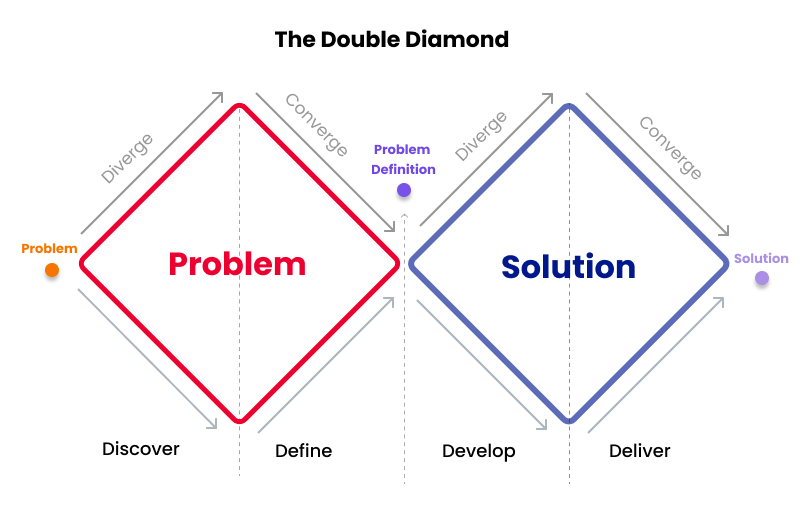
The Double Diamond methodology in UX design originated from the Design Council, a British organization that promotes the value of design in society. The concept was first introduced in the early 2000s as a way to illustrate the divergent and convergent stages of the design process.
How Design Council explains the Double Diamond
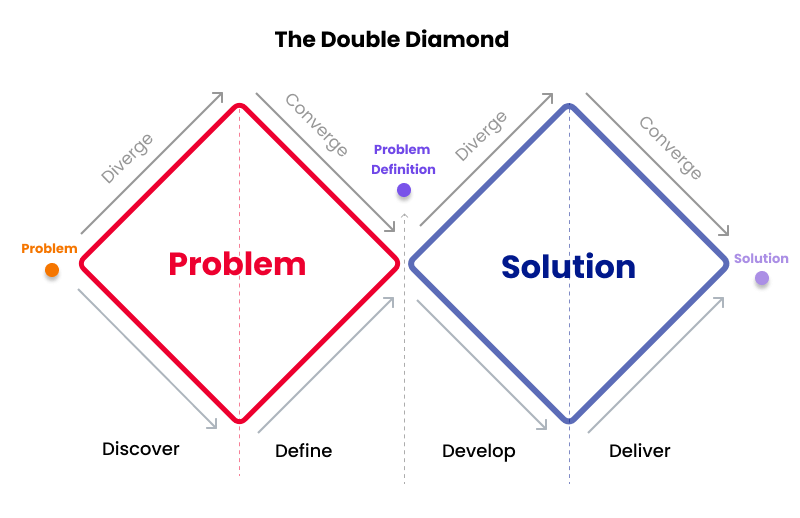
The Double Diamond methodology emphasizes divergent and convergent thinking, encouraging designers to explore a wide range of possibilities before arriving at the best solution. It consists of four main stages: Discover, Define, Develop, and Deliver.
1 Discover (Divergent Thinking):
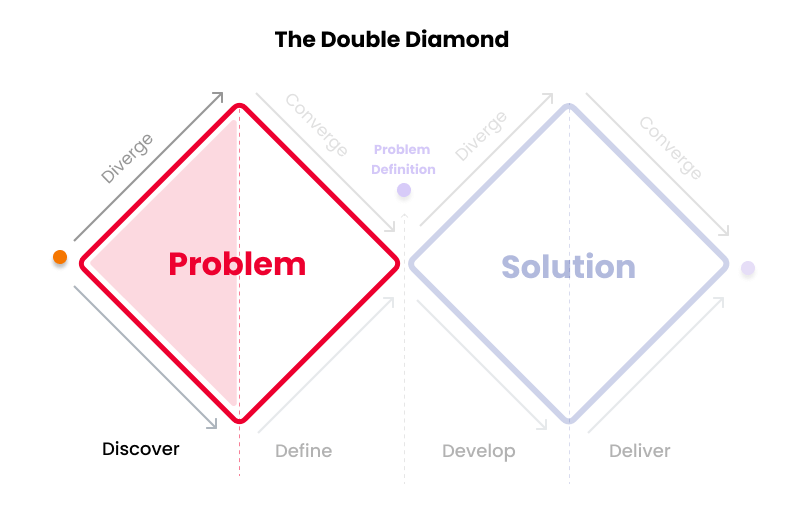
The first step in the Double Diamond process is the discovery phase. During this phase, designers aim to gain a deep understanding of the problem by exploring user and business needs. Various research methods, such as user interviews, surveys, and competitive analysis, are employed to collect qualitative and quantitative data. By identifying pain points, strengths, and opportunities, designers can uncover valuable insights that improve the design process.
Therefore, the understanding phase in the UX design process is very important. You can find successful companies that interview their users and develop successful apps because they meet what the end customer wants. Let’s look at a real example to illustrate this.

If you think about the difference between Uber and street taxis, something that Uber did very differently early on is understand and look at the behavior and pain points of its customers, its users, and people who wanted to get from A to B. The two things they identified through a series of surveys and observational interviews were:
- A significant pain point was the process of ordering a car and the uncertainty about arrival time.
- Another sticking point came at the end of the trip, when passengers had to look for cash or find out if credit cards were accepted, and needed to leave and be on time for their appointment.
And these are the two major pain points: asking for a car and getting off. Because they did the research and understood where the main pain points were when using these types of services, they were able to completely change the way these things were done and make the process seamless. But they understood user pain because they did the research and took the time to improve the user experience. This is where the understanding phase of the UX design process is so valuable.
2 Define (Convergent Thinking):

Once the discovery phase is complete, the designer moves into the definition phase. Here, they summarize the findings and prioritize the most critical areas that need to be addressed. Designers work with stakeholders to define clear goals, product requirements, and feature priorities.
For this phase, it is necessary to prepare documents to define the ideas. Crucially, at this point the problem statement must be clear: “What problem are we trying to solve?”. To do this, we can conduct workshops and create documents together with our team and customers, such as:
- The “5 whys” is a problem-solving technique that involves repeatedly asking “why” to discover the root cause of a problem. By delving into the underlying reasons for a problem, the 5 Whys method helps to identify the root cause rather than just addressing the symptoms.
- Affinity diagrams are a visual tool used in user surveys and brainstorming sessions to organize and categorize ideas or data. By grouping related concepts, affinity diagrams make it easy to identify patterns, insights, and potential solutions.
- The user story is a concise narrative that describes a specific user’s interaction with a product or service. It typically includes the user’s purpose, the context of use, and the expected result. User stories are commonly used in agile development to communicate user needs and guide the design and development process.
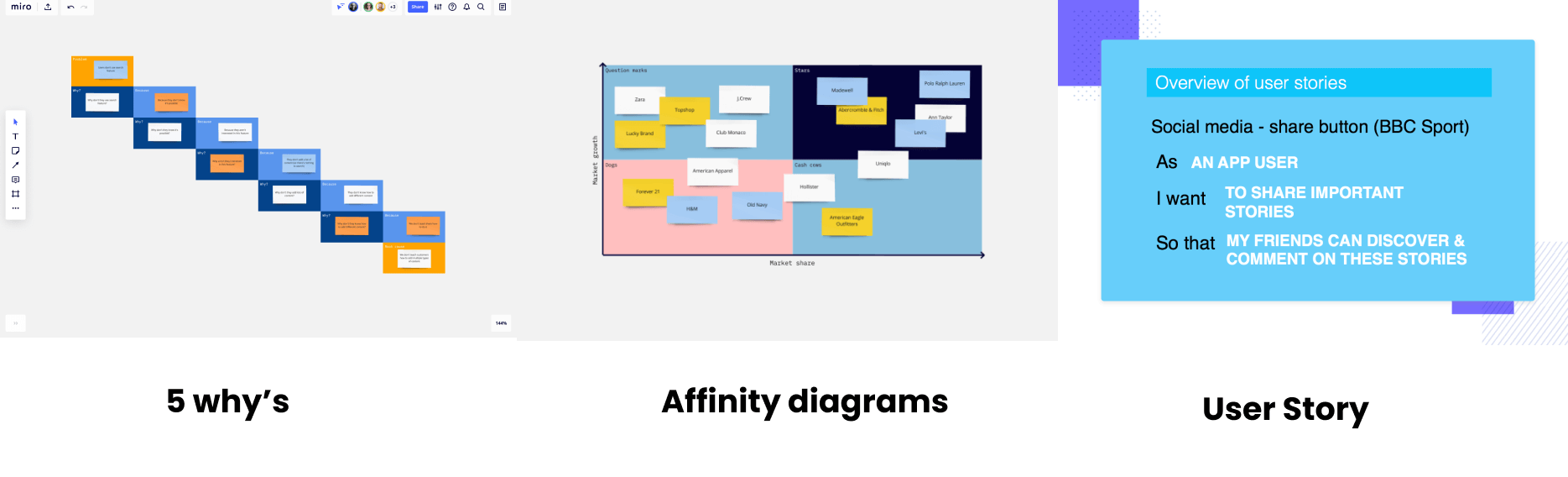
By the end of this phase, we aim to have a thorough understanding of the problem at hand. Typically, this phase results in a problem statement that succinctly summarizes and defines the issue we are attempting to solve.
3 Develop (Divergent Thinking):

With a clear focus on the problem statement and UX documentation in place, designers enter the Develop phase. This step involves generating a wide range of design solutions and exploring different possibilities. Sketching, brainstorming, and prototyping are common techniques used to visualize and iterate on ideas.
So, now that we understand where the problems and frustrations lie, we can come up with ideas on how to resolve those issues. The goal is to take what we know and come up with multiple ways to potentially solve it.
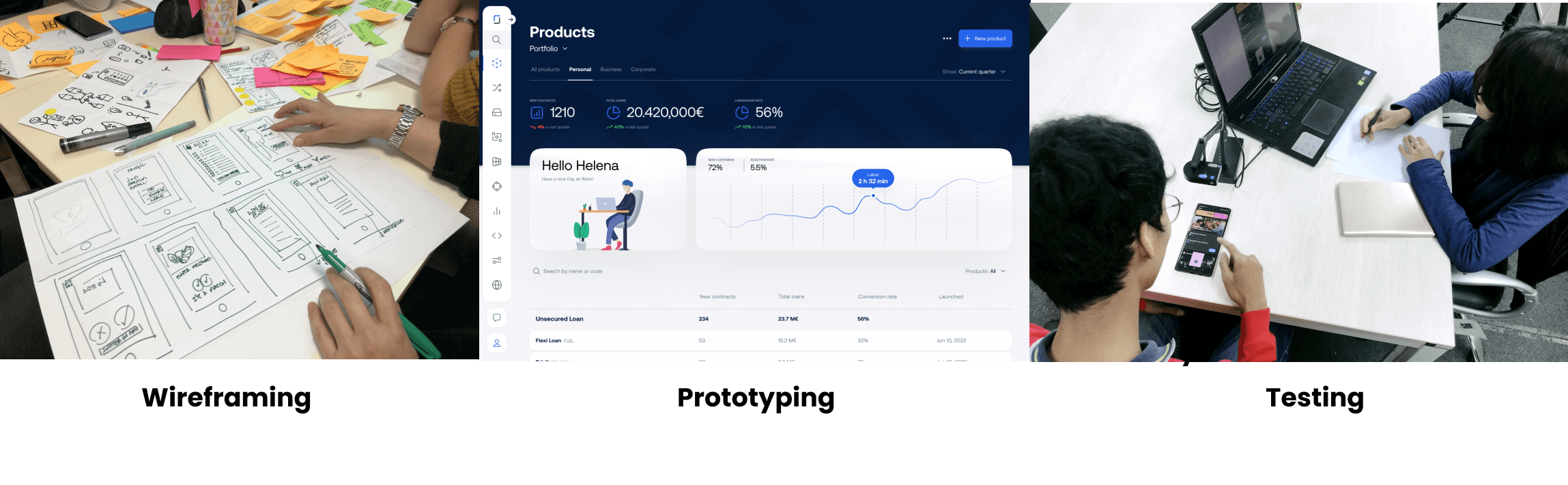
This is also a really fun internship that can be done in many different ways, with workshops, sketches, and tests to validate findings.
- Wireframing is a technique used in the early stages of design to create a visual representation of the layout and structure of a digital interface.
- Prototyping is the process of creating a preliminary version or model of a product or system to visualize and test its design and functionality.
- Design testing involves evaluating the usability, effectiveness, and overall user experience of a product or system.
4 Deliver (Convergent Thinking):

The final step in the Double Diamond process is Delivery. In this phase, designers refine and validate their design solutions through testing and user feedback. Defining the design based on user insights helps fine-tune designs, ensuring they effectively address identified users and business issues.
In the final phase what we have as a result is a high fidelity prototype that presents all the details and functionalities that will meet what the user needs, making sure that the best solution has been found for the digital product.
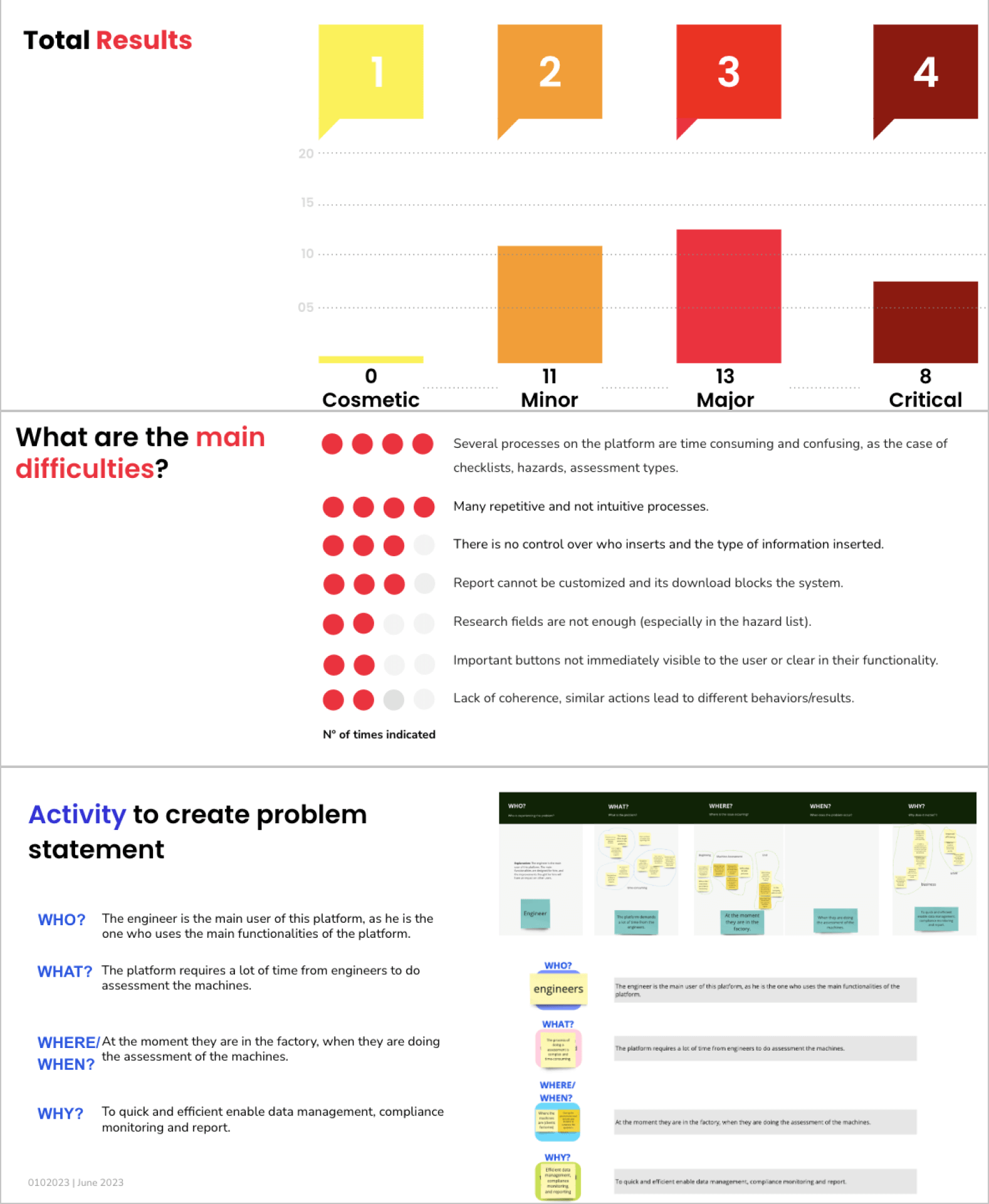
We also deliver a final report that serves as a comprehensive summary of the design process and results. It describes key findings, insights, and recommendations derived from each phase of the process. The report provides a detailed overview of the research carried out, identified user needs, the explored design concepts, and the final solution developed.
Includes visual aids such as:
- High fidelity prototypes
- Detailed design specifications
- Usability test results
- User feedback and insights
Additionally, the report highlights the solution’s impact on user experience metrics, business objectives, and any notable improvements observed.
By presenting the report, designers effectively communicate the value and effectiveness of their design decisions, ensuring a shared understanding between the design team and the customer.
Conclusion
Finally, I bring another example of a successful user-centered design approach. Airbnb is a homestay rental marketplace that allows users to list and book accommodation worldwide. The company has grown rapidly over the past few years, and its user experience (UX) has played a huge role in its success.
These are just some of the UX techniques Airbnb uses to create a great user experience.
User-centric design: Airbnb’s UX team puts the user at the center of every decision they make. They conduct user research to understand their needs and pain points and use that information to guide their design decisions.
Design System: The UX team at Airbnb uses rapid prototyping to quickly and easily test new ideas. This allows them to iterate on their designs and improve them based on user feedback.
A/B testing: Airbnb uses A/B testing to compare different versions of its website and app to see which one performs better. This helps them identify the best design options for their users.
Continuous improvement: Airbnb’s UX team is constantly iterating its designs to improve the user experience. They use data and user feedback to identify areas for improvement and make changes accordingly.
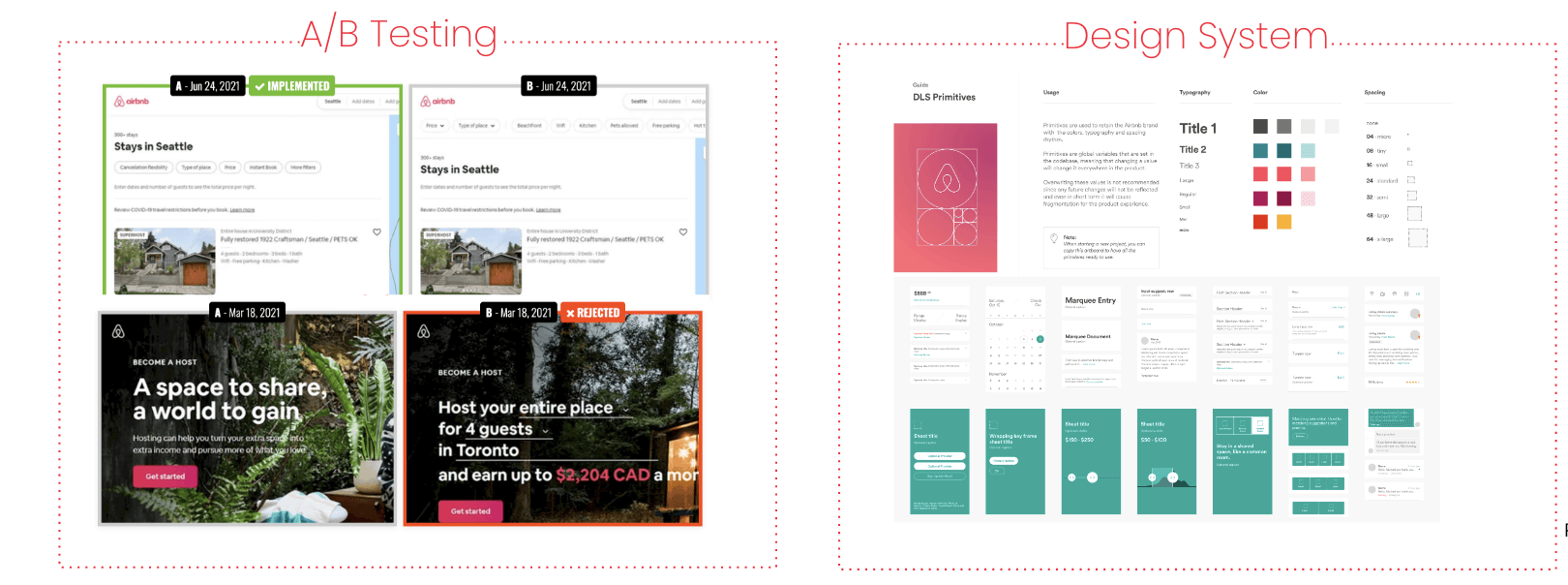
Airbnb’s success is due in large part to its focus on user-centered design. The company’s designers put the needs of the user first, and they test their designs extensively to ensure that they are easy to use and enjoyable. This focus on user experience has helped Airbnb to make the act of “sleeping at a stranger’s house” a normal and trusted activity.
In conclusion, the Double Diamond UX process provides a comprehensive framework for tackling complex design challenges. Its four distinct phases, Discover, Define, Develop, and Deliver, allow designers to explore, understand, envision, and refine their solutions in a structured, iterative manner. By diverging and converging at each stage, designers can generate a wide range of ideas, critically analyze them, and turn them into tangible, user-centric designs.
The Double Diamond process emphasizes empathy, collaboration, and continuous learning, ensuring the final product meets user needs and provides an enjoyable experience. By taking this holistic approach, designers can navigate the complexities of the design landscape, discover innovative solutions, and create impactful experiences that resonate with users.