As AI moves from experimentation to enterprise scale, the methodology we choose, in the digital product landscape, may no longer be just a “way of working” and become a strategic business decision (Mckinsey; IBM).
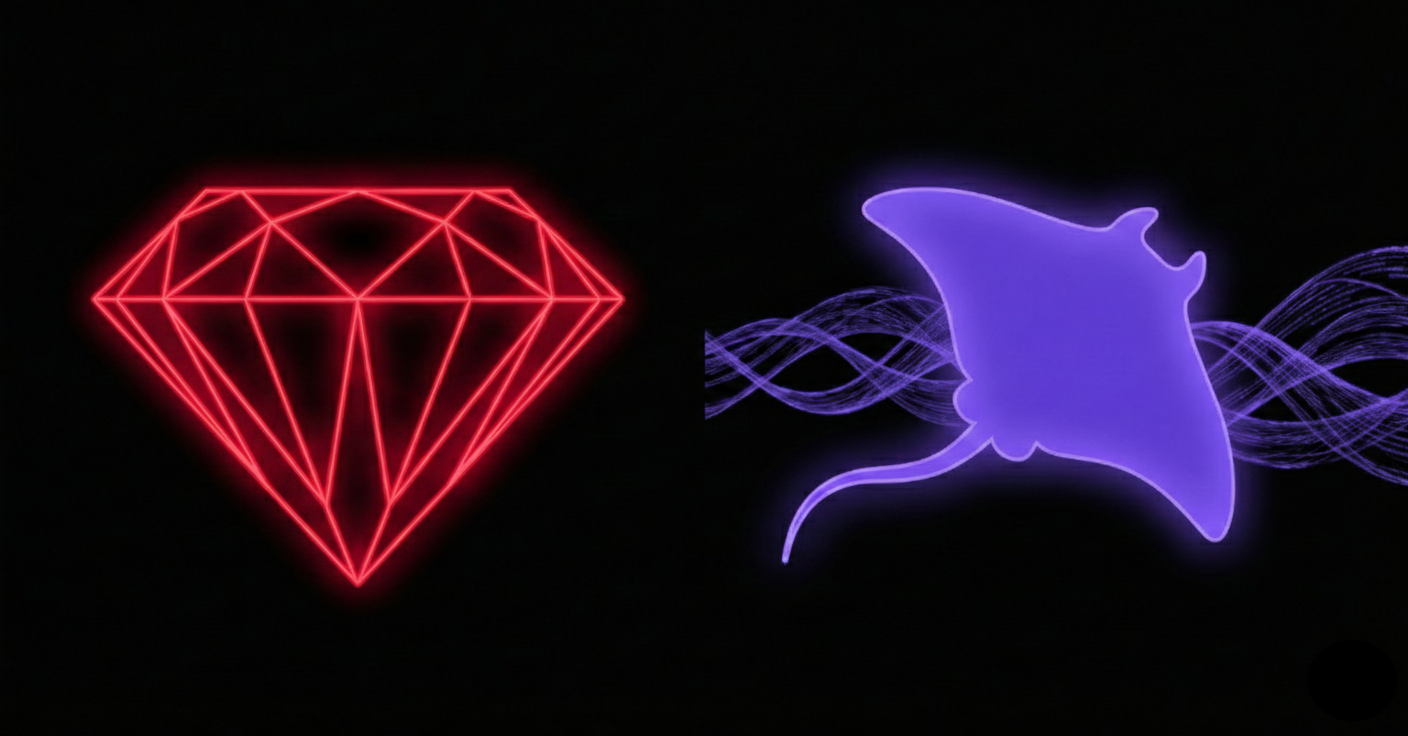
For years, the Double Diamond has been the industry’s North Star for navigating ambiguity. However, as AI compresses timelines and the “handover” between design and engineering tends to evaporate, the Stingray Model has emerged to address the need for continuous, integrated velocity.
Is understanding these models really about choosing a favorite, or is it about knowing which gear to engage, to reach your destination?
The Models Explained
Double Diamond: From a Linear Model to Systemic Design

Popularized in 2004, when the British Design Council decided to create a visual representation to explain the value and mechanics of design to non-designers, the Double Diamond guides teams from initial problem identification through to the final solution.
This iterative process helps designers tackle complex challenges by deeply understanding user pain points, generating and testing ideas, and ensuring a user-centered approach.
By establishing a rhythm of divergent thinking (going wide to explore) and convergent thinking (narrowing down to focus), the model serves as a roadmap through the chaos of innovation and design process, empowering UX teams through four key phases:
- Discover: Diverging to explore the problem space through broad research.
- Define: Converging to identify the specific challenge to solve.
- Develop: Diverging to ideate multiple potential solutions.
- Deliver: Converging to prototype, test, and finalize the solution.
Its primary value is de-risking: it structurally prevents teams from committing the most common product failure – prematurely jumping to solutions before fully validating the underlying challenge.
It aims to ensure that the team is solving the right problem for the right user.
Far from being a static model, it has adapted, transitioning from a linear process to an iterative, organic ecosystem focused on global impact.
The Agile Era and the Break from Linearity
With the explosion of User Experience (UX) Design and Agile methodologies, the British Design Council recognized that successful innovation requires more than just a methodological process, it depends heavily on the surrounding environment.
Recognizing these organic changes, the Design Council updated the model in 2019 to the Framework for Innovation. This update enveloped the classic geometric diamonds within a broader ecosystem, highlighting the crucial role of an open organizational culture and strong leadership. Furthermore, it formalized core guiding principles for teams – such as continuous iteration, inclusive collaboration, visual communication, and human-centeredness – acknowledging that the real-world design process is an inherently non-linear and dynamic journey.

Systemic Innovation and the Future
Most recently, in response to complex global challenges like climate change and social inequality, the model underwent its most profound transformation with the release of the Systemic Design Framework (2021).
This contemporary iteration expands the focus from a strictly human-centered approach to a planet-centered, systemic perspective. It challenges practitioners to constantly “zoom in” on immediate user needs and “zoom out” to understand the invisible interconnections and environmental impacts within a larger ecosystem.
By integrating new overarching activities – such as orienting, narrative building, and connecting stakeholders – the modern Double Diamond has evolved from a simple product development guide into a strategic instrument for designing sustainable, regenerative, and system-wide interventions.
Stingray Model: The Engine of Integration

Born from the current AI revolution, the Stingray Model, was introduced by Board of Innovation in a webinar titled “Death of the Double Diamond and the new AI-powered Stingray model”, as the framework they design to integrate Artificial Intelligence into the innovation process.
Unlike other models, it leverages AI to accelerate data processing and ideation, progressing through three distinct, AI-amplified phases:
- Train (Setting the Context): This phase focuses on “Information Gathering” and “Model Training”. Instead of manual discovery, teams collect vast amounts of data – including academic research, competitor products, and market trends – to understand the specific challenges.
This data is used to train the AI model to identify key problem areas and potential solutions.
- Develop (Exponential Exploration): This phase combines “AI-led ideation with human expertise”. The AI generates a massive array of potential solutions.
Human experts then step in to “break, stretch, and rebuild” these ideas, using their intellect to refine concepts before asking the AI to critique them and prioritize them into predefined groups.
- Iterate (Synthetic & Real Testing): The final phase introduces “AI-led synthetic testing,” where the AI simulates consumer behavior to predict outcomes and refine features. This is followed by “Human-led experimentation,” where the most promising ideas are prototyped and tested in the real world once confidence in the solution is high.
This model prioritizes feasibility and viability from day one, ensuring the design is technically and commercially ready for launch immediately. This is exactly where the Stingray Model shines – it forces the conversation about “Can we build this?” to the very beginning of the process.
The 6 Key Differences
I. Discovery: Manual Empathy vs. AI Training
The Double Diamond treats discovery as a manual, “Up-Front” investment of weeks or months, spent gathering empathy and mapping journeys.
The Stingray Model shifts this to a “Train” phase. It involves feeding an AI model with existing client information and manufacturing capabilities to identify opportunities and validate assumptions in hours, not weeks. Discovery becomes a data-ingestion engine rather than just an interview process.
Keep in mind: We must be cautious not to let AI replace genuine human empathy.
II. Information Flow: Sequential vs. Collaborative Cycles
While visually sequential, the Double Diamond allows iteration between phases.
The Stingray is collaborative and recursive. In the Stingray’s “Develop” phase, the flow isn’t A-to-B; it is a cycle where human intellect breaks down AI-generated ideas, and AI is immediately asked to critique the human refinement.
III. The Role of the Prototype
In the Double Diamond, a prototype is often a “facade” used late in the process to test an idea.
In the Stingray Model, testing begins before the prototype exists via Synthetic Testing. AI simulates user personas to provide feedback on complexity before a physical or digital model is even built.
IV. Risk Management vs. Speed to Market
The Diamond is designed to prevent Strategic Failure (building the wrong thing).
The Stingray is designed to prevent Operational Failure (being too slow or building something impossible to scale).
By categorizing and prioritizing ideas using AI in the Develop phase, the Stingray model ensures feasibility is assessed alongside creativity, ensuring that technical constraints are the “bones” of the design, not an afterthought.
V. Measurement of Success
Double Diamond success is measured by validation (Did we solve the user need?).
Stingray success is measured by velocity and precision. It asks: How effectively did we use “AI + Human Collaboration” to turn an insight into a live feature that generates ROI?.
Keep in mind: We must not forget that success should also be measured through user validation, usability metrics, and long-term adoption.
VI. Human Allocation: Specialization vs. Orchestration
Perhaps the most critical shift is how teams deploy their most valuable asset: human talent.
- The Double Diamond relies on serialized specialization. Researchers dominate the first diamond, designers lead the second.
- The Stingray Model relies on orchestration. Because AI handles the heavy lifting of “Idea Generation” and “Synthetic Testing”, human effort shifts from production to curation and critical thinking. The model is not removing humans from the loop; it is moving them up the value chain to focus on judgment rather than execution.
Keep in mind: The human expert can not be replaced. While synthetic testing can accelerate early validation, it should not replace real-world qualitative research, as there is a risk of bias and unreliability.
Strategic Synergy: Finding the Balance
The AI Accessibility Myth
A common misconception is that adopting an AI-driven framework like the Stingray Model requires millions in custom machine learning infrastructure. In reality, the barrier to entry is gone. Enterprise-grade foundational models and generative UI tools are available at a fraction of the cost of a single developer’s weekly sprint.
The differentiator no longer seems to be technological access, but operational maturity.The true edge in the use of AI is the quality of the input. According to Mckinsey, the competitive advantage belongs to those who know how to feed secure AI environments with the right research and design constraints, effectively ‘teaching’ the model the nuances of a specific business challenge.
We must keep in mind that AI should be a partner, not a replacement. High-quality output still demands human oversight, as current tools operate much like interns – excelling only when provided with clear instructions, context, and constraints (NN/g).
The Verdict: Augmenting the Diamond with the Stingray Engine

The industry debate often frames the Double Diamond and the Stingray Model as competitors – a forced choice between structure and velocity.
For me, modern product leadership may not be about discarding the Diamond, but about asking: How can the Stingray Model accelerate the phases of the Double Diamond?
Rather than a simple transition from one framework to another, I see the Double Diamond as the architecture of problem-solving and the Stingray Model as the propulsion engine that moves them through it.
Here is how I see their characteristics complement each other to reduce time, cut costs, and identify risks faster:
- Accelerating Discovery (Train + Discover/Define): The first diamond traditionally demands deep research, broad exploration, and time-intensive synthesis. While this rigor remains essential, AI can significantly compress the effort required to move from raw information to structured insight.
By applying a “Train” logic before or alongside discovery, we can use AI to ingest and organize large volumes of material – academic research, market signals, internal documentation, analytics data, support tickets, and historical project knowledge. Instead of replacing research, AI acts as a preprocessing layer: clustering themes, summarizing findings, highlighting correlations, and surfacing recurring friction points.
AI can also support activities, such as:
- Drafting research plans and interview guides
- Generating proto-personas to test early assumptions
- Conduct early desk research
- Summarize qualitative interviews
- Help identify patterns
This allows us to enter the Define phase with a clearer landscape of signals and hypotheses, reducing manual tagging and accelerating synthesis without eliminating human interpretation.
We cannot forget, as highlighted by the Nielsen Norman Group, that we must be cautious not to let AI replace genuine human empathy. While AI can accelerate analysis, it cannot fully substitute the direct observation of human behavior and the deep, nuanced understanding that comes from real-world interaction.
- Supercharging Ideation and Feasibility (Develop + Develop): The beginning of the second diamond is intentionally divergent – a space for exploration, alternative directions, and reframing solutions. AI can significantly expand this exploration layer by rapidly generating multiple structural, interaction, and content variations based on defined constraints.
Instead of manually sketching a limited set of wireframes, we can use AI to:
- Produce multiple flow variations from the same problem statement
- Suggest alternative interaction patterns
- Generate layout compositions using existing design system components
- Create microcopy and tone variations for different contexts
- Simulate edge cases and alternate user paths
We then curate, stretch, and rebuild these ideas. Because the AI evaluates technical capabilities simultaneously, we don’t just ideate faster – we ensure that feasibility is locked in before development is even involved, drastically reducing the risk of costly rework.
- De-risking Delivery (Iterate + Deliver): The final phase of the Double Diamond focuses on validating and refining solutions before release. Traditionally, this involves prototyping, usability testing, accessibility checks, and multiple rounds of iteration. AI can meaningfully reduce friction in this stage – not by replacing testing, but by front-loading technical validation and accelerating analysis.
Before high-fidelity or fully functional prototypes are built, AI can support early “synthetic” evaluations by:
- Scanning flows for logical inconsistencies or broken interaction paths
- Identifying potential cognitive overload (e.g., excessive steps, dense information clusters)
- Highlighting missing states or edge cases
- Stress-testing navigation structures against defined user roles
While AI cannot anticipate the unpredictable, emotional, or contextual behaviors of real users, it can surface structural weaknesses early – allowing us to correct obvious issues before investing heavily in development.
During usability testing and post-test analysis, AI can further support by:
- Transcribing moderated sessions
- Structuring observational notes
- Clustering feedback into themes
- Cross-referencing behavioral data with qualitative insights
We can dedicate more time to interpretation, identifying subtle behavioral patterns, and crafting strategic recommendations rather than manually organizing transcripts.
In summary, I believe that the future of UI/UX is not found in a single shape, but in the fluid orchestration of human strategy and AI-amplified velocity.
The Double Diamond ensures we are climbing the right mountain, and the Stingray Model provides the AI-amplified velocity to climb it faster.
So, how we blend these characteristics – how much AI synthesis we use to inform human empathy, or how much synthetic testing we run before real-world validation – is the new art of product design.